Developer Insights: CI/CD Beyond Code – Automating Security & Compliance Checks
Introduction
Modern CI/CD pipelines used to focus almost entirely on build, test, and deployment. But as software systems matured — and as security threats grew more sophisticated — organisations realised that code quality alone wasn’t enough. Today’s pipelines must ensure that applications are not only functional but also secure, compliant, and aligned with organisational policies before they ever reach production.
Security and compliance are no longer afterthoughts or manual gatekeeping steps. They are integral parts of the delivery pipeline. By embedding these checks directly into CI/CD, teams create a safer, more reliable, and more auditable path from development to production.
Why Security & Compliance Must Shift Left
When vulnerabilities are discovered late — during staging or after release — they become costly, disruptive, and risky. Shifting security and compliance earlier into the pipeline (“Shift Left”) prevents problems before they enter production.
This shift is driven by several realities:
- Code dependencies change rapidly and carry hidden risks.
- Infrastructure as Code (IaC) can introduce misconfigurations at scale.
- Cloud-native systems add complexity across environments.
- Regulatory requirements demand audit-friendly, traceable workflows.
Integrating these checks into CI/CD ensures that every change — code, configuration, dependency, or policy — is validated consistently, not manually.
What Security & Compliance Automation Looks Like
Security automation in CI/CD goes far beyond basic linting or code scanning. It covers the entire ecosystem: application code, infrastructure definitions, container images, API behavior, secrets, and access patterns.
Steps in a Security-Integrated CI/CD Pipeline
- Static Code Analysis (SAST) — scan code for vulnerabilities, insecure patterns, and unsafe functions.
- Dependency & SBOM Validation — evaluate third-party packages, generate software bills of materials, and identify risky libraries.
- Secrets Detection — prevent API keys, tokens, or credentials from entering version control.
- Infrastructure as Code Scanning — validate Terraform, CloudFormation, and Kubernetes manifests for misconfigurations.
- Container Image Scanning — check base images and layers for vulnerabilities before deployment.
- Policy Enforcement — use tools like OPA to enforce organisational policies on services, roles, configurations, and resource usage.
- Runtime Security Checks — simulate deployments or run dynamic scans to detect vulnerabilities during execution.
Each of these steps strengthens the pipeline without slowing down developers.
Security-Integrated CI/CD Pipeline Architecture
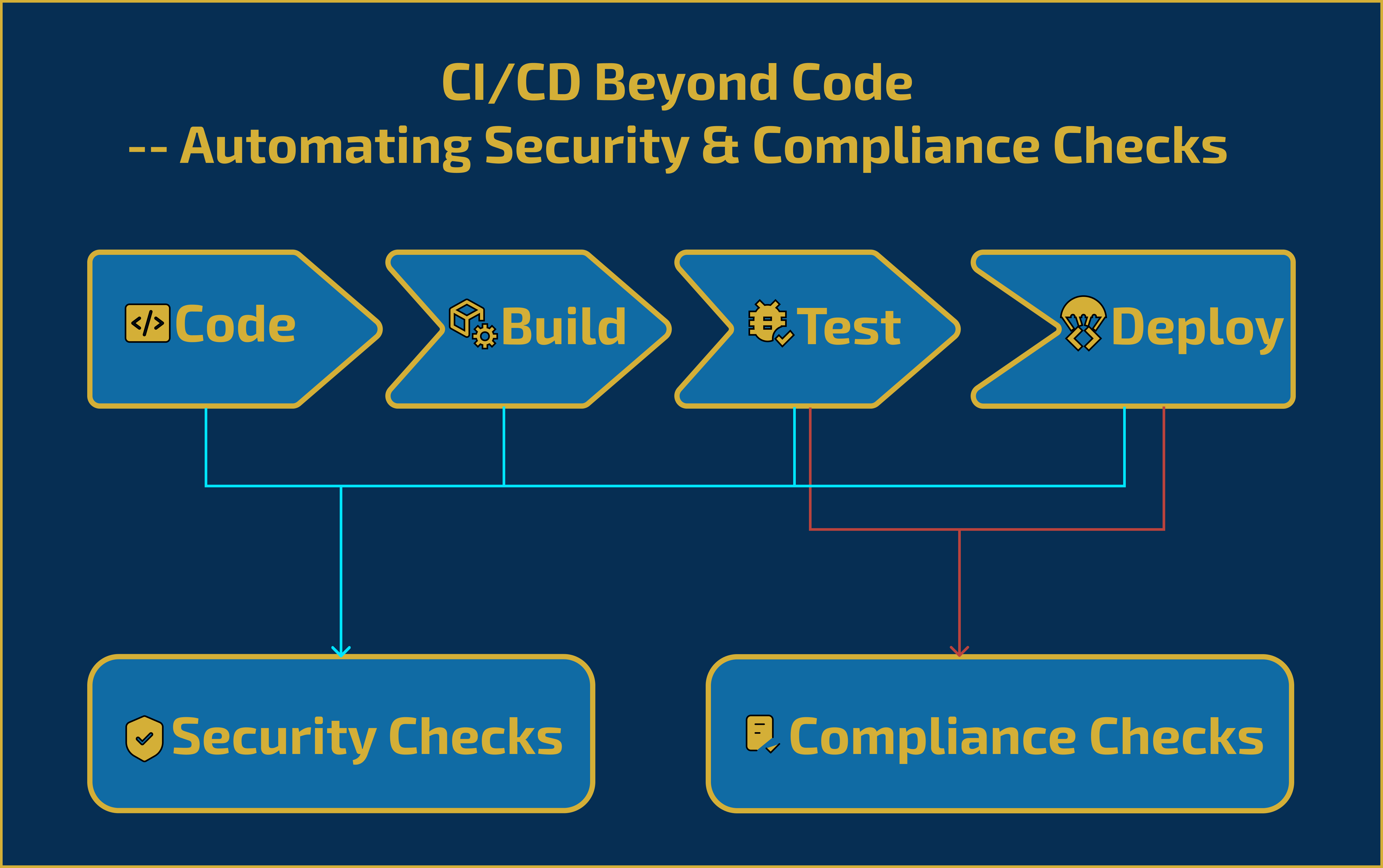
Figure: How automated Security and Compliance checks integrate into each stage of a modern CI/CD pipeline.
Automating Compliance in CI/CD
Security ensures your system is protected; compliance ensures your system follows rules — internal, external, or regulated.
Automation helps avoid human bottlenecks and audits that slow down releases.
Compliance automation covers:
- access control validation,
- change tracking and approvals,
- artifact signing and verification,
- encryption enforcement checks,
- audit log consistency,
- permission and policy validation.
By embedding controls into CI/CD, organisations maintain consistent governance and reduce the risk of non-compliance across multiple environments and teams.
Tools That Enable This Level of Automation
Several platforms have become core to security-driven pipelines. They help ensure that vulnerabilities, misconfigurations, and violations are caught early and addressed automatically.
Popular categories include:
- SAST Tools: Semgrep, SonarQube, CodeQL
- Dependency Scanners: Snyk, Trivy, OWASP Dependency-Check
- Secrets Detection: GitGuardian, TruffleHog, Gitleaks
- Container Scanning: Anchore, Clair, Trivy
- IaC Scanning: Checkov, Terrascan, tfsec
- Policy Enforcement: OPA / Conftest, Kyverno
- Runtime Testing: OWASP ZAP, Burp Suite automated pipelines
These tools integrate seamlessly with GitHub Actions, GitLab CI, Jenkins, Bitbucket Pipelines, and AWS/GCP/Azure DevOps systems.
Benefits of Automating Security & Compliance
Adding security and compliance into CI/CD brings tangible engineering and organisational benefits.
It reduces rework, improves trust, and accelerates delivery.
Best Practices for a Security-Driven CI/CD Pipeline
- Treat security as code — version it, test it, and automate it.
- Build pipelines that fail fast when critical vulnerabilities appear.
- Use organisation-wide templates to maintain consistency across teams.
- Apply policy-as-code solutions (OPA, Sentinel, Kyverno) for clear governance.
- Integrate SBOM generation into all builds for supply-chain visibility.
- Use secrets managers (Vault, AWS Secrets Manager, GCP Secrets Manager) instead of manual secrets.
- Monitor pipelines continuously to detect new vulnerabilities.
Every change should automatically go through these checks — no exceptions.
Conclusion
CI/CD is no longer just a delivery mechanism — it has evolved into a central trust layer for software organisations. By embedding security, compliance, and policy enforcement into the pipeline, teams ensure that every release meets organisational and regulatory standards without slowing down development.
The future of CI/CD is not just automated builds and deployments. It’s automated safety, automated governance, and automated accountability. Teams that adopt this approach build software that is secure by default and compliant from day one.
Key Takeaways
- CI/CD pipelines now include security, governance, and compliance checks — not just code builds.
- Shifting left reduces risk and prevents costly fixes later in the lifecycle.
- Tools across SAST, IaC scanning, container scanning, and policy enforcement are central to modern pipelines.
- Compliance becomes continuous when integrated into automated workflows.
- The future of CI/CD is secure, auditable, and governed at every stage.
References
Comments
Add Your Comment
Related Posts
Production Engineering: What Incident Timelines Don’t Show
0 12
Production Engineering: Technical Debt — When to Fix, When to Ignore
0 105
Engineering Decisions: What Makes Senior Engineers Valuable Beyond Code
0 109
AI Foundations Bundle — From AI Basics to Deep Learning & NLP
Learn AI the right way — from core concepts to deep learning and language models, all in one structured bundle.
Ideal for beginners and developers who want a complete AI roadmap without confusion.
No comments yet. Be the first to comment!