Developer Insights: AI Code Assistants – Do They Really Boost Developer Productivity?
Introduction:
AI code assistants have moved from side experiments to mainstream development tools. Whether it’s GitHub Copilot, Amazon Q, Cursor, CodeWhisperer, or ChatGPT-based workflows, developers today increasingly rely on AI to suggest code, generate boilerplate, review pull requests, and even explain unfamiliar APIs.
But with this rise comes an important question: Do AI code assistants genuinely improve developer productivity, or do they simply make coding feel faster?
Understanding their true impact requires looking beyond hype and focusing on how they affect accuracy, velocity, cognitive load, and long-term engineering practices.
How AI Code Assistants Support Developers?
Modern code assistants work by analysing context — the current file, surrounding code, comments, and sometimes entire repositories — to provide suggestions that feel contextual and human-like. Instead of manual searching or repetitive typing, assistants can produce code patterns instantly.
They are particularly useful in areas such as:
- Reducing repetitive coding
- Helping with unfamiliar languages or frameworks
- Catching small issues early
- Creating starter templates
- Speeding up exploration and prototyping
- Explaining complex code for onboarding
These advantages, used correctly, can significantly reduce the mental overhead of development.
Where AI Assistants Create Real Productivity Gains?
1. Faster Boilerplate and Repetitive Work:
Developers often spend a large portion of time writing similar patterns — CRUD handlers, API wrappers, test scaffolding, deployment configs. AI assistants handle these quickly, freeing developers to focus on logic and design.
2. Better Flow State:
Instead of breaking focus to search documentation or Stack Overflow, developers get instant answers inline. Staying in flow improves overall velocity and reduces context switching.
3. Accelerated Learning Curve:
New team members or those exploring new stacks can understand codebases faster through explanations, suggested patterns, and guided corrections.
4. Early Bug Detection:
Assistants catch syntax errors, missing imports, unhandled exceptions, and common pitfalls. While not a replacement for tests, this shortens the feedback loop.
5. Higher Throughput in Prototyping:
Early-stage design exploration becomes quicker because developers can test multiple approaches rapidly without writing everything manually.
When used responsibly, these benefits are genuine and measurable.
Where AI Productivity Gains Plateau?
AI assistants are not perfect. They offer speed, but speed alone does not equal productivity in the holistic engineering sense.
1. Incorrect or Suboptimal Code:
AI often generates code that works but isn’t optimal, idiomatic, or secure. Developers must validate suggestions carefully, especially in production systems.
2. Reinforcing Bad Patterns:
AI mirrors patterns that exist across the internet, including outdated or deprecated practices. Without discipline, teams may accumulate technical debt faster.
3. Reduced Deep Understanding:
Over-reliance may impact long-term comprehension of architecture, algorithms, or debugging practices. Productivity may increase short-term but reduce long-term skill depth.
4. Security Blind Spots:
Assistants may generate insecure defaults — weak IAM policies, unvalidated inputs, poorly handled exceptions. Human review is essential.
5. Variability Across Languages and Frameworks:
Performance varies widely by ecosystem; AI is strong in Python, TypeScript, and Go, but less reliable in niche or rapidly updating frameworks.
This shows that productivity improvements depend heavily on how teams use AI — not only on the tool itself.
Best Practices for Using AI Assistants Effectively:
- Use AI for scaffolding, not architectural decisions.
- Review every suggestion like a PR from a junior developer.
- Avoid copy-pasting unverified code into critical systems.
- Use AI to explain unfamiliar code — not to bypass understanding.
- Prefer writing initial logic yourself and letting AI refine it.
- Use assistants inside well-tested environments to detect regressions.
- Keep security practices front and center; validate IAM, regex, and input handling.
AI helps most when developers remain intentional and maintain engineering discipline.
Do AI Assistants Truly Boost Productivity?
The short answer: Yes — but only when used correctly.
AI code assistants provide meaningful gains in:
- Reducing cognitive overhead
- Increasing iteration speed
- Improving developer onboarding
- Enhancing flow state
- Automating low-level tasks
But they do not replace engineering reasoning, and they can introduce risk when used without review.
Teams that benefit the most treat AI as a collaborative coding partner — not a decision-maker. Productivity increases when developers stay in control, validate every suggestion, and leverage AI to accelerate the parts of development that matter less creatively.
Conclusion:
AI code assistants represent a significant shift in how software is built. They don’t eliminate the need for deep engineering skills, but they amplify developer abilities by automating repetitive tasks, accelerating learning, and reducing context switching. When balanced with strong code review, testing, and architectural thinking, they offer measurable productivity gains.
In the coming years, as these systems integrate more deeply with IDEs, CI pipelines, and code intelligence platforms, AI-assisted development will become the norm — not the exception. Developers who learn to use these tools responsibly will multiply their output without compromising quality.
Key Takeaways:
- AI assistants boost productivity primarily by reducing repetition and improving flow.
- They accelerate prototyping and onboarding but must be used with careful review.
- Incorrect, insecure, or outdated patterns remain a risk without human oversight.
- Productivity gains depend on intentional use, not passive reliance on generated code.
- AI is a multiplier for disciplined engineering — not a replacement for it.
References:
Comments
Add Your Comment
Related Posts

Production Engineering: Technical Debt — When to Fix, When to Ignore
0 96
Engineering Decisions: What Makes Senior Engineers Valuable Beyond Code
0 103
Engineering Decisions: Code Reviews That Actually Improve Systems
0 93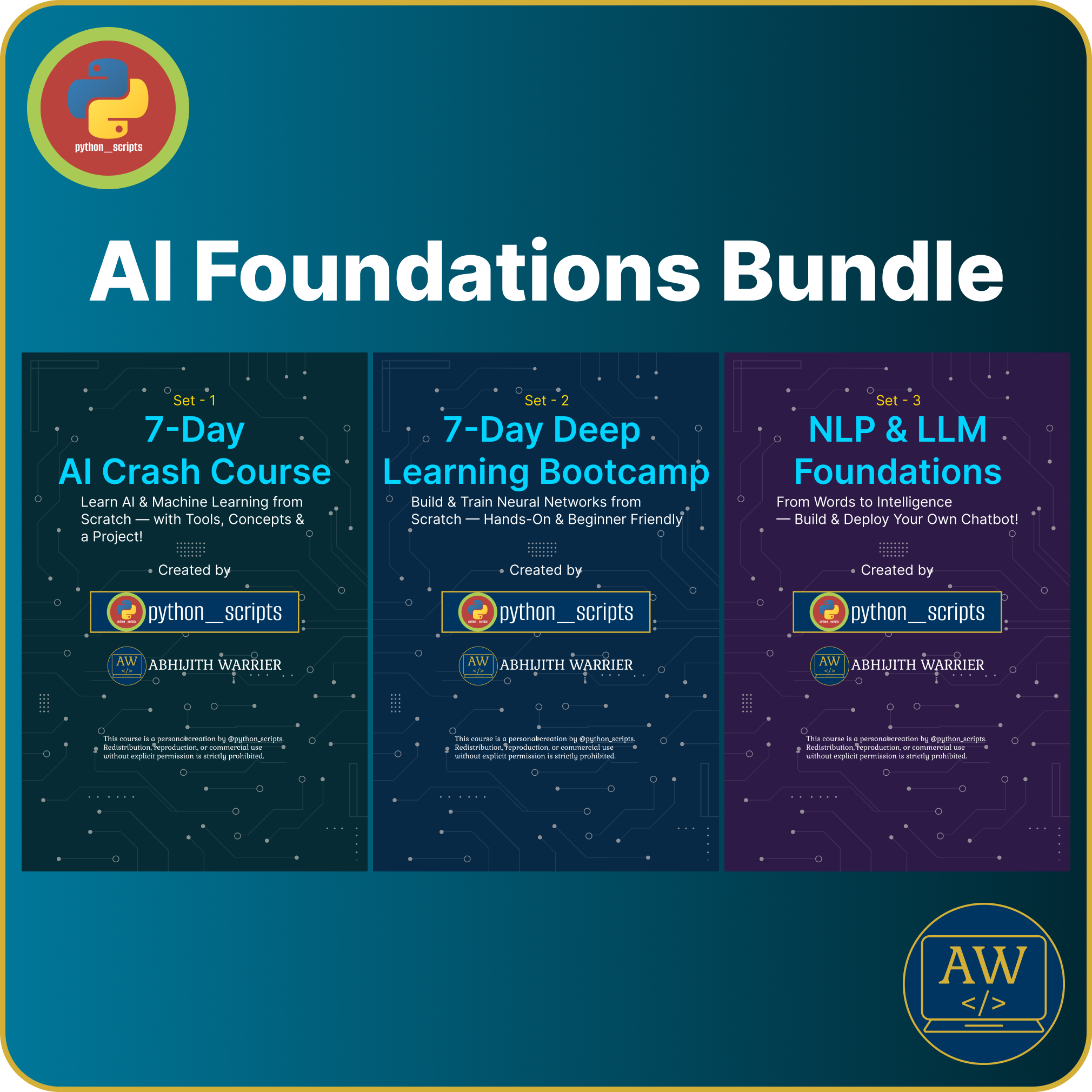
AI Foundations Bundle — From AI Basics to Deep Learning & NLP
Learn AI the right way — from core concepts to deep learning and language models, all in one structured bundle.
Ideal for beginners and developers who want a complete AI roadmap without confusion.
No comments yet. Be the first to comment!