AI Insights: AI Guardrails — Preventing Hallucinations in Production
Introduction:
One of the most visible failure modes of AI systems is hallucination — confident outputs that are incorrect, misleading, or fabricated.
In demos, hallucinations are often tolerated. In production, they become serious risks. Incorrect recommendations, fabricated data, or misleading responses can damage user trust and create real operational or legal consequences.
The challenge is not eliminating hallucinations entirely. It is designing systems that limit their impact and detect them early.
That is where guardrails come in.
Hallucinations Are a System Problem, Not Just a Model Problem:
It’s easy to blame the model.
But hallucinations are often amplified by system design. Lack of context, unclear prompts, missing validation, and absence of fallback mechanisms all contribute to incorrect outputs.
Improving the model alone rarely solves the issue. Guardrails must be implemented at the system level.
Constraining the Problem Reduces Risk:
Generative models perform better when the problem space is narrow.
Open-ended prompts increase variability. Constrained inputs, structured queries, and well-defined tasks reduce the chances of incorrect responses.
Guardrails often begin by limiting what the model is asked to do.
Grounding Responses Improves Reliability:
Ungrounded generation is more prone to hallucination.
Providing the model with trusted context — such as internal documents, databases, or retrieval systems — improves accuracy. When outputs are tied to known sources, the model has less room to fabricate.
Grounding turns generation into guided reasoning.
Validation Layers Catch Incorrect Outputs:
No system should rely solely on model output.
Validation layers act as checkpoints. These can include:
- rule-based checks
- schema validation
- consistency checks against known data
- secondary models for verification
These mechanisms don’t prevent hallucinations entirely, but they reduce the likelihood of incorrect outputs reaching users.
Confidence Signals Must Be Interpreted Carefully:
Model confidence is not always reliable.
High-confidence outputs can still be wrong. Systems that treat confidence as truth risk propagating errors without friction.
Instead, confidence should be combined with other signals such as context coverage, input ambiguity, and validation results.
Human-in-the-Loop Is a Critical Safeguard:
For high-impact decisions, human oversight is essential.
Escalating uncertain or sensitive cases to human review provides a safety net. This is particularly important in domains involving finance, healthcare, or compliance.
Human-in-the-loop is not a temporary solution. It is a permanent part of robust AI systems.
Observability Helps Detect Drift and Failure Patterns:
Hallucinations are not always random.
They often increase when input patterns change or when the model is applied to new contexts. Monitoring outputs, tracking error patterns, and analyzing user corrections provide early signals.
Observability turns hidden failures into visible trends.
Fallback Mechanisms Preserve User Trust:
When the system is uncertain, it should degrade gracefully.
Instead of producing incorrect outputs, systems can:
- return partial answers
- ask for clarification
- defer to deterministic systems
- escalate to human review
Fallbacks maintain trust even when the model cannot provide a complete answer.
Guardrails Are an Architectural Layer:
Guardrails are not a single feature.
They are a combination of constraints, validation, monitoring, and fallback strategies integrated into the system. Treating guardrails as an afterthought leads to fragile systems.
Designing them early makes AI behaviour more predictable and manageable.
Conclusion:
Hallucinations are an inherent characteristic of generative AI, not a temporary bug.
Production systems succeed not by eliminating them, but by controlling their impact. Guardrails provide the structure needed to make AI systems safer, more reliable, and more trustworthy.
In production, intelligence without guardrails is risk. Intelligence with guardrails becomes usable.
Comments
Add Your Comment
Related Posts

AI Insights: When NOT to Use Generative AI in Enterprise Systems
0 34
AI in Production: AI Observability — Monitoring Models, Prompts, and Drift
0 35
AI in Production: AI Failures in Production — What Went Wrong
0 90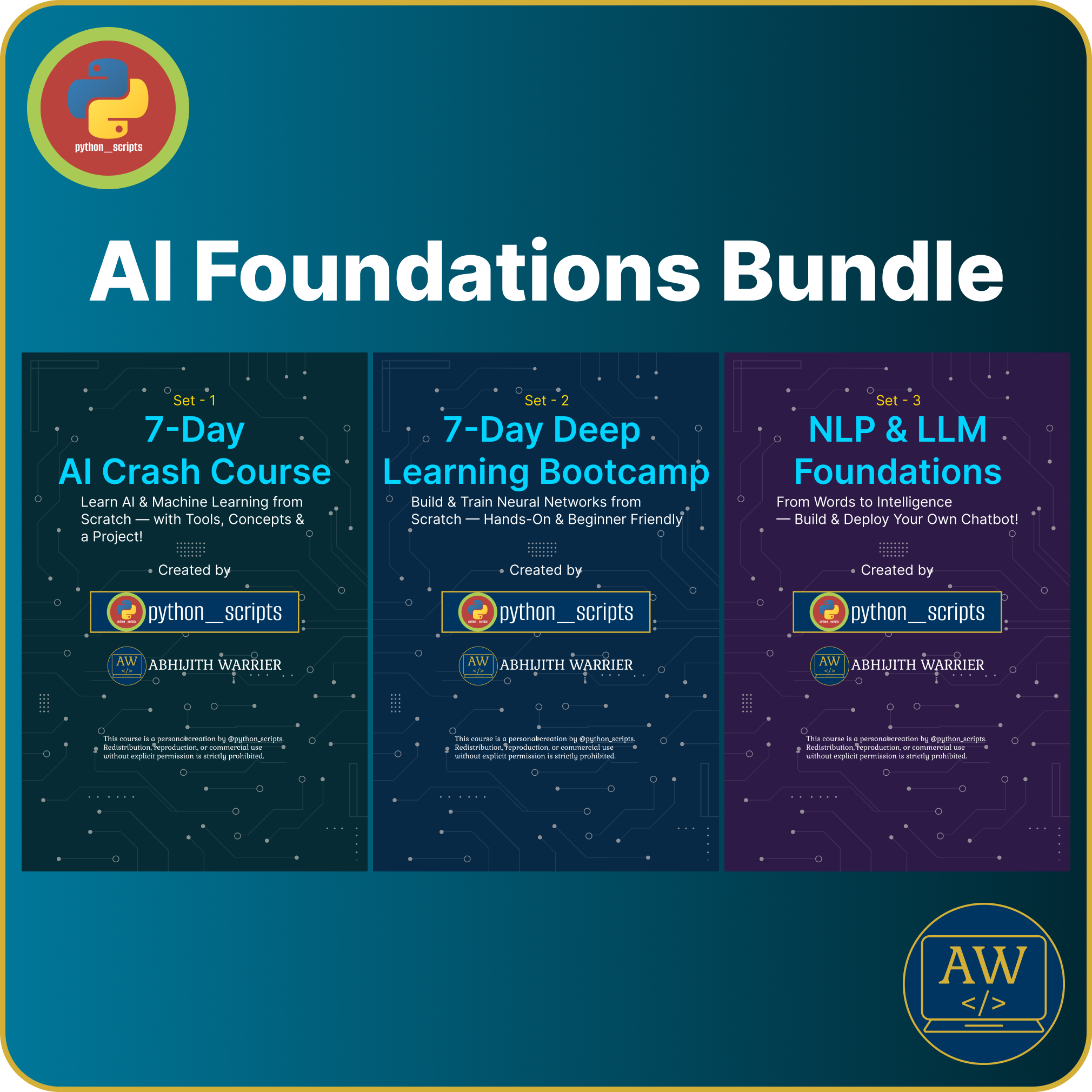
AI Foundations Bundle — From AI Basics to Deep Learning & NLP
Learn AI the right way — from core concepts to deep learning and language models, all in one structured bundle.
Ideal for beginners and developers who want a complete AI roadmap without confusion.
No comments yet. Be the first to comment!