
AW Dev Rethought Flash: When the Trust Itself Breaks — The eMudhra CA Compromise
There’s a category of security incident that’s worse than a data breach. A breach exposes data. What happened to eMudhra this week exposed something harder to recover: trust.
On October 17, a security researcher reported that eight private keys belonging to eMudhra’s intermediate certificate authorities had been compromised. Not stolen from a server. Not leaked through a misconfigured bucket. Computed — derived directly from the public certificates using basic mathematics — in under a second.
By October 20, Chrome and Firefox had blocked all eight certificates. Emergency patches were shipping across Go, Node.js, Python, Ubuntu, Debian, and Cloudflare. eMudhra’s stock fell 20% in a single session in Mumbai. India’s Ministry of Electronics formed an investigation team.
The vulnerability had existed, undetected, for 18 months.
What a Certificate Authority Actually Does
To understand why this matters, you need to understand what CA trust means in practice.
When your browser visits a website over HTTPS, it checks the site’s certificate against a chain that leads back to a trusted root CA. The browser trusts the root; the root vouches for intermediate CAs; the intermediate CAs issue certificates to websites. The whole system — every HTTPS connection, every signed software package, every government digital signature — rests on the assumption that CA private keys are secret and unguessable.
eMudhra is one of India’s largest Certificate Authorities. Its Indian digital signature services (DSC and eSign) run on separate infrastructure and, according to MeitY and eMudhra, were not affected. The compromised keys belong to its global web certificate business, which is embedded in browsers, operating systems and runtimes worldwide.
When a CA’s private key is compromised, the attacker can issue a certificate for any domain — sbi.co.in, incometax.gov.in, anything — that browsers will accept as legitimate. That’s the basis for man-in-the-middle attacks, traffic interception, and impersonation of any site in the CA’s chain.
What Went Wrong
In April 2025, eMudhra conducted a key ceremony — the formal, controlled process for generating CA private keys. A flaw in that ceremony generated a second, weak set of keys alongside the intended ones. The weak set, not the strong set, was what got published to root stores.
The weakness: insufficient randomness during key generation. Cryptographic keys need entropy — unpredictability — to be secure. These keys had so little entropy that a researcher could reconstruct all eight private keys from the public certificates alone.
Security researcher Scott Helme recovered all eight keys in under a second.
For 18 months, those keys sat in root stores trusted by browsers, operating systems, and runtimes worldwide. Anyone who knew the weakness — or discovered it independently — could have been issuing fraudulent certificates the entire time.
Whether anyone did is still unknown. Chrome’s search of Certificate Transparency logs found no TLS certificates chaining to the six web-facing intermediates. But CT logs don’t cover everything, and past misuse of the code-signing intermediates has no equivalent detection mechanism.
The Blast Radius
The immediate fixes came fast. Chrome and Firefox blocked the eight certificates within hours of the October 17 report, before it was even made public. But “browsers are fixed” is only part of the story.
Many software stacks verify TLS connections using system or bundled root stores — not the browser’s. Go binaries, Python’s certifi bundle, Node.js applications, container images — all of these maintained their own trust stores and needed separate patches:
- Go — versions 1.27.3 and 1.26.10 reject chains with the compromised keys; any binary compiled against older versions needs a rebuild
- Node.js — versions 26.12.1, 24.22.1, and 22.23.4 carry the fix
- Python
certifi— updated to drop the affected roots - Ubuntu / Debian —
ca-certificatespackages updated - Cloudflare — patched
WARP,1.1.1.1clients, andcloudflaredbefore public disclosure
Red Hat Enterprise Linux had no package yet as of disclosure; a manual workaround is available. macOS’s built-in curl was still accepting the chain.
Chrome plans to remove the emSign ECC Root CA - G3 root entirely around October 27. Legitimate sites still chaining to that root will break for users. Operators have days to reissue certificates.
The Deeper Problem
This incident is not just about eMudhra. It’s about what happens when the infrastructure of trust is itself fragile.
Key ceremonies are supposed to be the most controlled events in a CA’s operation — air-gapped hardware, witnesses, formal procedures, audit logs. The April 2025 ceremony produced weak keys and nobody caught it. The certificates were accepted into root programs. They sat there for 18 months.
The WebPKI — the system of root stores and certificate chains that secures the internet — works on the assumption that CAs are trustworthy and competent. When a CA fails at the most basic cryptographic operation, the entire downstream ecosystem bears the cost: emergency patches, potential certificate errors for legitimate sites, and an 18-month window of unknown exposure that can never be fully audited.
A certificate authority’s one job is to be certain about identity. When the authority itself can’t be trusted, the chain breaks from the root.
What Developers and Teams Should Do Now
If your application, service, or pipeline verifies TLS connections:
- Check your Go, Node.js, and Python versions — patch to the fixed versions listed above
- Rebuild any Go binaries compiled before October 20
- Audit your container base images and update
ca-certificates - If you use
cloudflaredor Cloudflare Zero Trust, update to2026.10.2 - If your origin certificate chains to
emSign ECC Root CA - G3, reissue before October 27
If you’re on Red Hat Enterprise Linux, apply the manual workaround from Red Hat’s advisory now — don’t wait for the package.
Final Thought
The eMudhra compromise will be patched. The keys will be revoked. The root will be removed. The immediate risk will pass.
What won’t pass is the question it leaves open: how many other CAs are running key ceremonies with the same flaw, and how long until someone notices?
 Most downloaded free PDF
50 Machine Learning Algorithms Cheatsheet
Blueprints of Intelligence — 50 ML Algorithms decoded
Enjoyed this post?
Stay in the loop
New posts + weekly digest, straight to your inbox.
Create a free account
- Save posts to your vault
- Like posts & build history
- New-post alerts
Comments
Add Your Comment
Related Posts
AW Dev Rethought Flash: SBI Data Is on BreachForums — And the Entry Point Is Still Unknown
1 93
AW Dev Rethought Flash: Japan Declares First Cyberspace Emergency — What Developers Need to Know
58
AW Dev Rethought Flash: Vercel Supply-Chain Incident – April 2026
161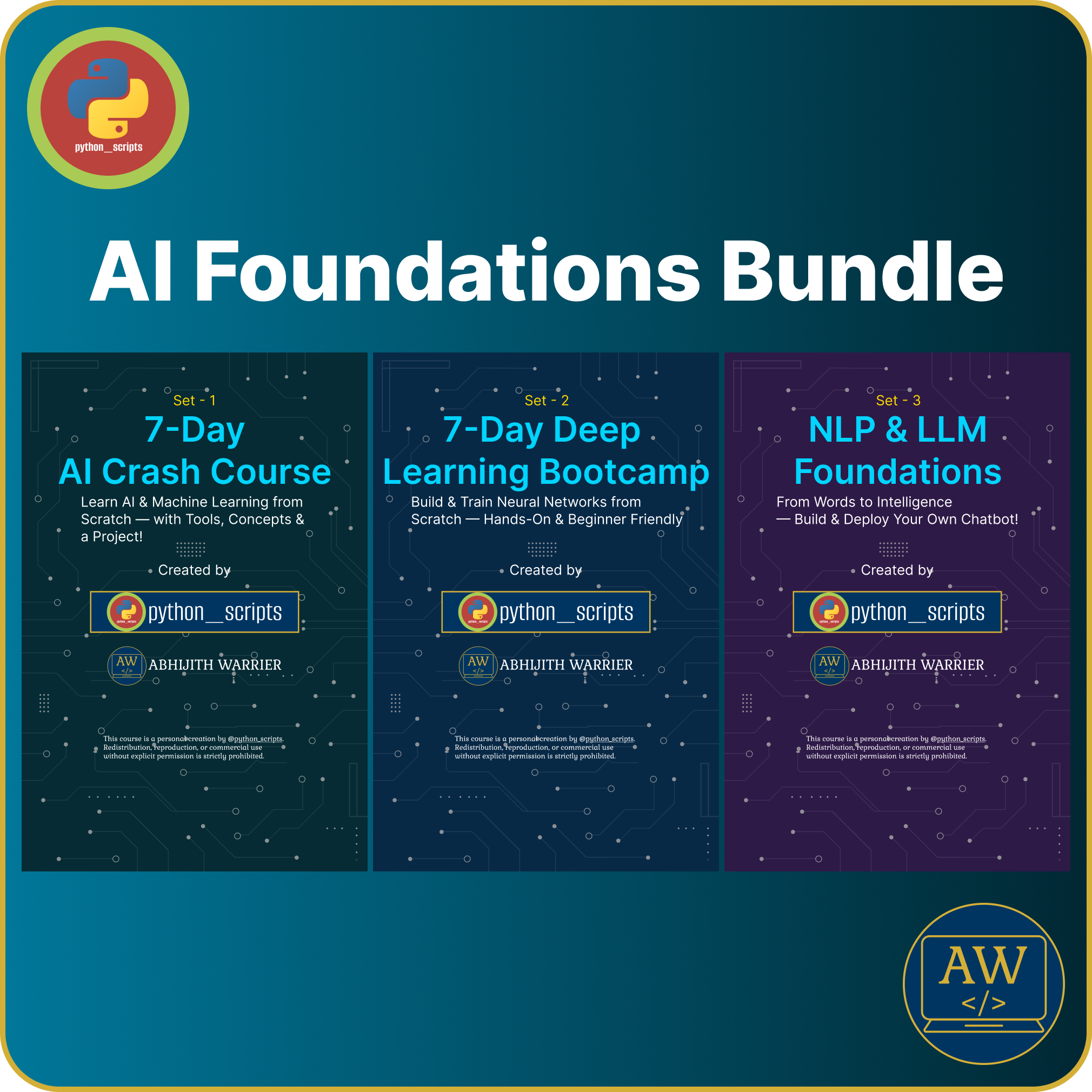
AI Foundations Bundle — From AI Basics to Deep Learning & NLP
Learn AI the right way — from core concepts to deep learning and language models, all in one structured bundle.
Ideal for beginners and developers who want a complete AI roadmap without confusion.
No comments yet. Be the first to comment!